
 0 Comments
Table of Contents
The National Grid Corp. of the Philippines (NGCP) is seeking regulatory approval to immediately implement a P2.82-billion transmission upgrade in Ilocos Norte aimed at addressing power quality issues and accommodating the rapid expansion of renewable energy projects in the province.
In an application filed with the Energy Regulatory Commission (ERC), NGCP said the Laoag Power Quality Improvement Project is designed to mitigate recurring voltage fluctuations at the Laoag substation, which have intensified following the connection of additional wind and solar power plants in the area.
Rising Renewable Capacity In Ilocos Norte
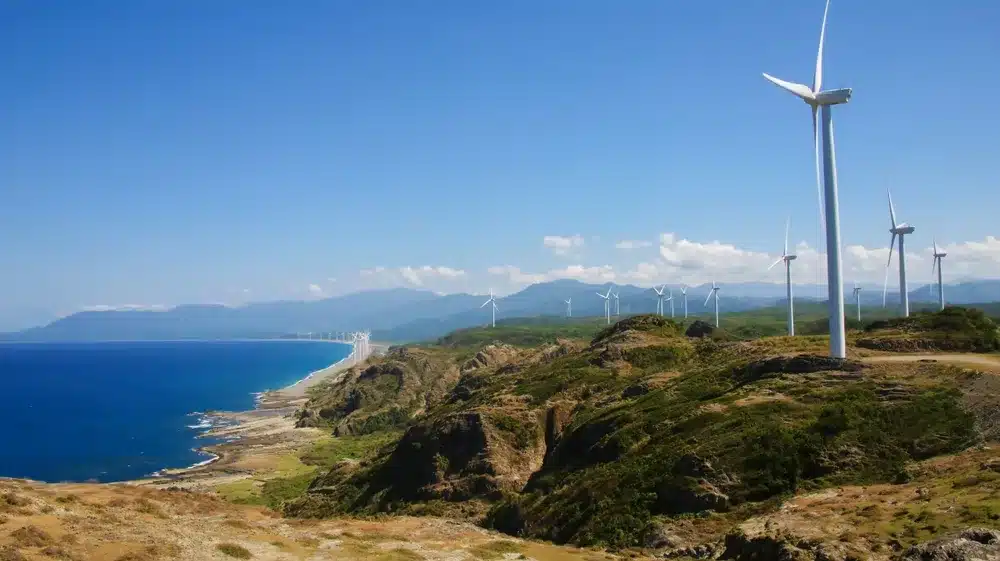
Ilocos Norte is one of the country’s major renewable energy hubs, with existing variable renewable energy (VRE) capacity totaling 546 megawatts (MW). Of this, 362 MW come from wind power facilities and 184 MW from solar plants.
NGCP said an additional 405 MW of VRE capacity—149 MW of wind and 256 MW of solar—is expected to come online between 2025 and 2026. This would bring the province’s total VRE capacity to about 951 MW, further increasing pressure on the local transmission system.
Voltage Fluctuations And Interim Measures
The grid operator warned that voltage fluctuations at the Laoag substation are likely to worsen as more intermittent renewable energy sources are connected to the grid. To temporarily manage the issue, NGCP adjusted voltage control settings at existing plants, raising the allowable VRE dispatch limit to 525 MW.
However, NGCP emphasized that these adjustments are not intended as a long-term solution. With more wind projects nearing commercial operation, the company said more robust grid support facilities are needed to maintain system stability and allow higher levels of renewable energy dispatch.
Technical Solution To Improve Grid Stability
Under the proposed project, NGCP plans to install a 50-megavolt ampere reactive (MVAR) grid-forming static synchronous compensator (GFM-STATCOM), complemented by two 25-MVAR, 230-kilovolt capacitor banks at the Laoag substation.
The GFM-STATCOM is capable of rapidly injecting or absorbing reactive power, which NGCP said is critical for precise voltage regulation and for mitigating the fluctuations inherent in variable renewable energy sources.
“With the implementation of the GFM-STATCOM, approximately up to 605 MW of VRE capacity can be accommodated in the Laoag area,” NGCP said. This represents an additional 80 MW of dispatchable renewable power compared to the current limit.
Regulatory Process And Project Timeline
NGCP estimates the project will take about 22 months to complete under a best-case scenario once approved. The company noted that transmission infrastructure requires long planning and construction timelines, making early regulatory clearance essential to keep pace with expected growth in renewable energy supply.
The project forms part of NGCP’s Transmission Development Plan for 2025–2050, which has been submitted to the Department of Energy for approval. Under the Electric Power Industry Reform Act of 2001, NGCP must secure ERC approval for major expansions or improvements to its facilities.
The ERC has found NGCP’s application sufficient in form and has scheduled a hearing on Feb. 10 for jurisdictional determination, expository presentation, and pre-trial conference.
NGCP, a private sector-led concessionaire, is responsible for developing, operating, and maintaining the country’s transmission network. Recently, the ERC approved the grid operator’s P11.86-billion Claver–Siargao Interconnection Project, highlighting continued efforts to strengthen transmission infrastructure in areas with growing power demand and renewable energy potential.
Source:
https://www.philstar.com/business/2026/01/25/2503209/ngcp-eyeing-p28-billion-grid-upgrade-ilocos
https://powerphilippines.com/ngcp-begins-stakeholder-talks-on-2025-2050-transmission-blueprint