
 0 Comments

Table of Contents
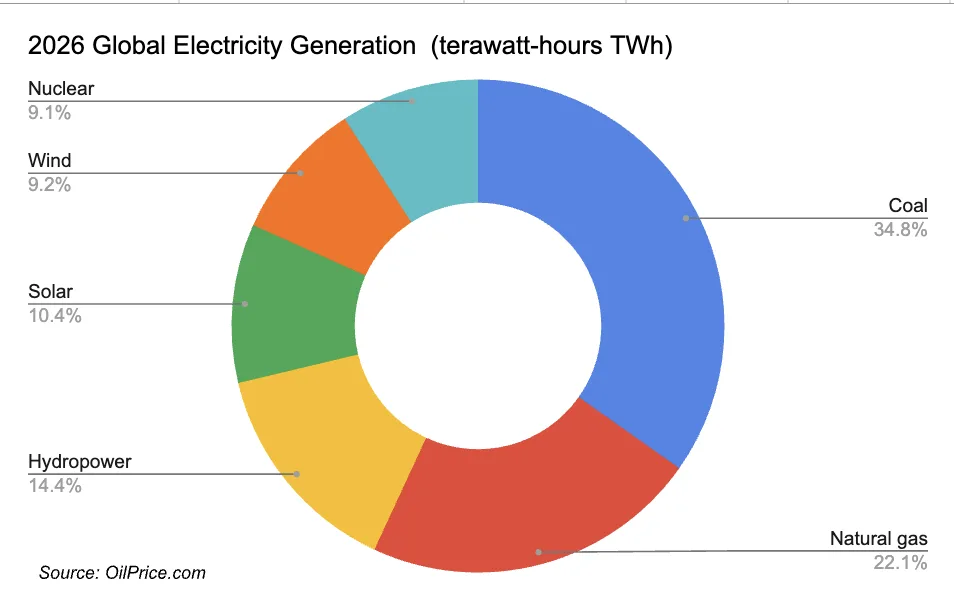
Coal is expected to remain the world’s biggest source of electricity in 2026. The International Energy Agency (IEA) projects coal-fired plants will generate 10,974 TWh, nearly one-third of global output.
That is about 57% more than natural gas, with hydropower, solar, wind and nuclear each producing less.
Renewables as a group are expected to overtake coal this year, but no single source comes close. Coal’s lead also reflects weaker gas markets, which could make coal more attractive for power generation.
(Also read: ACEN Drops 456-MW Solar Projects In Quezon, Zambales Over Land Hurdles)
China Remains Coal’s Biggest Driver
China remains the biggest force shaping the global coal market, consuming about 30% more coal than the rest of the world combined.
Coal use in industry continued to weaken in advanced economies in 2025, while demand from China’s traditional heavy industries also softened as cement and steel production moved past their peaks. The decline, however, was offset by stronger use in other industries, particularly China’s growing reliance on coal for chemical production.
That shift in industrial demand came alongside a sharp expansion in China’s coal-fired power capacity. New plant commissioning accelerated in 2025 after a surge in project approvals from 2022 to 2024, following earlier power shortages. Much of the added capacity is intended to handle peak electricity demand and strengthen the country’s energy security.
Its coal-fired power generation is also expected to rebound this year after a decade of declines, as extreme weather, the Iran war and slower growth in renewable output leave coal helping to meet rising electricity demand.
China’s coal rebound highlights the challenge of cutting emissions while keeping pace with soaring electricity demand. Growth in electric vehicles, data centers and other industries is putting added pressure on the power grid, even as Beijing works to reduce its reliance on coal.
At the same time, China is expanding clean energy at a record pace. As the world’s largest coal consumer and renewable-energy market, it is adding massive amounts of solar and wind power to meet growing demand. Yet the sheer scale of its electricity needs means coal remains a major part of the power mix, even as its share of generation declines.
War’s Energy Ripple Effect
The IEA began 2026 expecting coal-fired power generation to decline. Its 2025 forecast projected a 1.3% drop as growing renewable output and cheaper natural gas pushed coal out of some power markets.
That outlook has since shifted. Disruptions to oil and liquefied natural gas (LNG) shipments through the Strait of Hormuz have driven gas prices higher across Europe and Asia, making coal more attractive to power producers that can switch between fuels.
The IEA now expects global coal demand to rise 1.2% in 2026 to a record 8.94 billion tonnes, as disruptions to gas and LNG supplies push some power producers back toward coal. Global coal production is still expected to top 9 billion tonnes for a third consecutive year.
The renewed pull toward coal poses another challenge for the global green transition. “Wind and solar can take an increasing share of annual generation, but utilities still need power when the wind slows, the sun goes down, or demand suddenly jumps. Natural gas has increasingly filled that role in markets trying to reduce coal consumption,” wrote Charles Kennedy of energy news site Oil Price. “So, when you take that cheap gas away, coal suddenly becomes more attractive.”
That dynamic is playing out in China, where the Iran war has disrupted LNG supplies and pushed up gas costs, adding pressure on the power system. With El Niño also affecting conditions and renewable generation struggling to keep pace with rising demand, China is turning back to coal.
Additionally, the country’s renewable power growth has lost momentum in 2026, with weaker winds, lower solar output in its western section and slower additions of new renewable capacity compared with 2025.
The global power sector is still moving toward cleaner energy, but the path is proving less straightforward.
The outlook for 2027 will hinge in part on what happens in the Strait of Hormuz. If LNG shipments recover, coal demand could ease. But if disruptions persist, the IEA said coal use could climb further.
Why Coal Still Matters in the PH
A shift toward cleaner power is gaining momentum in the Philippines, driven by faster renewable energy (RE) development and growing interest in nuclear power, according to the IEA. It also pointed to the government’s recent policies, including the Green Energy Auction (GEA), as important steps toward attracting investment in the country’s energy transition.
However, that transition was tested when the Philippines declared a national energy emergency on March 24, 2026, amid the Middle East conflict and its threat to global energy supplies.
The crisis prompted a return to coal imports. President Ferdinand Marcos Jr. said, “We are trying to move away from coal, but because of this crisis we will reopen the importation and buying of coal so that our power plants do not run short of fuel, and to ensure that our power supply remains sufficient, especially across all parts of the Philippines.”
According to the Philippine Daily Inquirer, coal still dominates the Philippine power mix because “it provides the lowest price yet delivers the most stable operation in electricity generation, despite the country’s aggressive renewable energy expansion.”
While the Department of Energy (DOE) imposed a moratorium on new coal-fired power plants in 2020 to curb emissions, the policy did not cover existing plants with prior expansion commitments.
The current supply crunch in the Visayas has highlighted the need to add capacity outside the moratorium. Several coal plants have faced forced outages and reduced operations, while multiple major units going offline at the same time have strained the region’s power supply.
“We need to build those that are not covered by the moratorium,” said DOE Undersecretary Rowena Cristina Guevara. The agency is moving to fast-track up to 5,000 megawatts (MW) of new coal capacity to help guard against blackouts. The agency has also warned that stalled projects could eventually lose their contracts.
Climate activists have called for the 5-GW gap to be filled with utility-scale solar, wind and battery storage. But Philstar columnist Boo Chanco argued that these sources cannot yet provide the round-the-clock reliability needed by heavy industries while maintaining grid stability.
He also highlighted the gap between a renewable project’s nameplate capacity and the power it actually delivers. A 4,000-MW solar project, for instance, would produce an average of roughly 800 MW at a 20% capacity factor, rather than supplying 4,000 MW continuously.
“We may need to install up to five times more solar capacity and pairing it with large-scale or commercial storage,” he explained. “Less than five percent of existing utility-scale solar installations in the Philippines have battery backup.”
Scaling up solar to close the power gap also raises questions about land use. One estimate suggests replacing the proposed coal projects with solar farms could require an area roughly twice the combined size of Manila and Quezon City. Agricultural groups have also voiced concerns that large solar developments could compete with land needed for food production.
Those trade-offs extend to the climate equation. The Philippines accounts for only about 0.45% of global annual CO₂ emissions, while adding 5 GW of coal capacity is estimated to increase its greenhouse gas emissions by 27 million tons from a 175-million-ton baseline. Against roughly 37.5 billion tons of global annual emissions, that would lift the country’s share only marginally, from about 0.45% to 0.52%.
Even IEA Regional Cooperation Center head Sue-Ern Tan acknowledged that though the Philippines’ RE gains are encouraging, the transition remains challenging in keeping electricity reliable and affordable.
“So you can’t switch straight away,” the IEA official said, pointing to the country’s continued dependence on coal for electricity.
(Also read: Alternergy Ramps Up Renewables Drive With ₱2-Billion Green Notes)
Coal Remains a Mainstay
Coal is expected to remain the world’s largest single source of electricity through 2030, even as renewable capacity expands at record levels. The challenge is compounded by rising power demand: the IEA projects global electricity consumption to grow 3.6% in 2026 and another 3.8% in 2027. As the world needs more electricity, replacing coal becomes a more difficult task.
“For renewables, it’s two steps forward, three steps back,” observed Kennedy. “Much of the new renewable generation being built has to meet new demand before it can displace coal.”
The IEA also stressed that coal demand across Southeast Asia is expected to stay strong through 2026 and 2027, driven by rising electricity needs and the threat of a strong El Niño. Demand across ASEAN is projected to reach about 574 million tonnes this year, with power generation accounting for most of the growth.
“El Niño conditions could provide further support for coal use by increasing cooling demand and reducing hydropower output,” warned the IEA.
For the Philippines, the regional outlook adds urgency to the DOE’s push to fast-track new coal capacity. Failure to bring that dependable power online could deepen the country’s energy shortfall, with knock-on effects on economic growth, investment, and poverty reduction.
Reliable power is critical to economic growth, with industry data cited by the Philippine Institute for Development Studies (PIDS) estimating that a nationwide outage lasting just five hours can cost about P556 million. A persistent 5-GW shortfall could mean recurring peak-hour blackouts and potentially hundreds of billions of pesos in lost industrial output each year.
For Manila Bulletin columnist Fil Sionil, the answer lies in a balanced energy mix. She argued that new, high-efficiency coal plants could serve as a transition bridge, producing more power with less fuel and lower emissions per kilowatt-hour while the Philippines builds enough renewable capacity to meet its baseload needs.
“The goal is not more coal forever,” she wrote. “The goal is enough reliable power to keep the transition from breaking down under the weight of its own ambition.”
Sources:
https://finance.yahoo.com/energy/articles/coal-remains-undisputed-king-global-000000074.html
https://www.philstar.com/business/2026/09/27/2559098/philippines-energy-transition-gaining-momentum
https://businessmirror.com.ph/2026/09/28/phl-introduces-most-fossil-fuel-re-policies-in-2026
https://newsinfo.inquirer.net/2198408/marcos-counting-on-coal-imports-for-stable-power
https://www.philstar.com/business/2026/08/31/2552877/doe-plans-restart-coal-capacity-buildup
https://business.inquirer.net/610792/el-nino-seen-to-drive-asean-coal-use
https://mb.com.ph/2026/06/12/a-perfect-mix
https://oilprice.com/Energy/Coal/Coal-Remains-The-Undisputed-King-Of-Global-Power.html