
 0 Comments
Table of Contents
When visitors stepped into the 2025 National Science and Technology Week (NSTW) in Laoag City, Ilocos Norte, one exhibit drew more than curious glances—it drew hope. Cagayan State University’s Converted Electric Tricycle, or C-Trike, was not just another prototype on display. It was a working solution to one of the Philippines’ most persistent problems: how to clean up the country’s most common form of local transportation without leaving drivers behind.
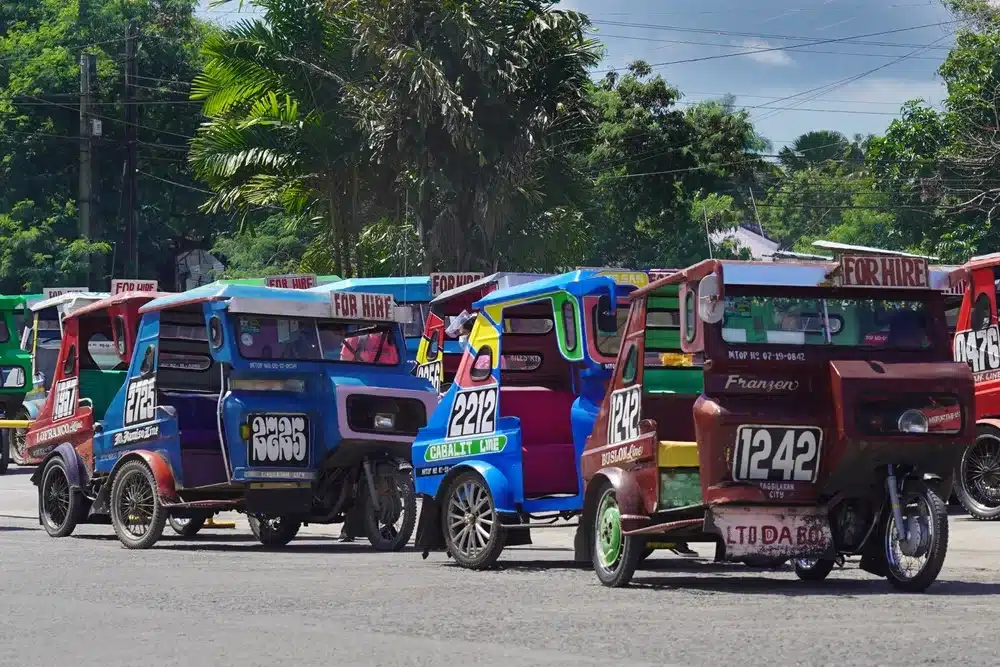
The humble tricycle remains the backbone of short-distance travel in many towns and cities. Yet most still rely on smoky two-stroke engines that clog streets with fumes and drain drivers’ earnings. The C-Trike replaces that aging heart with a fully electric power system, transforming an everyday vehicle into a zero-emission ride capable of travelling up to 80 kilometers on a single charge.
Behind the machine is the ElectroMobility Research and Development Center (EMRDC) of Cagayan State University (CSU), working closely with the Department of Science and Technology’s Philippine Council for Industry, Energy and Emerging Technology Research and Development (DOST-PCIEERD), DOST Region 2, and the University of the Philippines Diliman.
With ₱79.4 million in total project funding under DOST’s Smart and Sustainable Communities Program, the initiative aims to move beyond pilot projects and into real streets, real routes, and real livelihoods.
(Also read: Isabela Solar Farm Marks Clean Energy Milestone)
From Concept to Community Solution
The idea of converting tricycles did not emerge overnight. As early as 2021, CSU researchers were already evaluating electric tricycles alongside conventional two-stroke and four-stroke units. Their studies showed that electric models could handle daily loads, last for tens of thousands of kilometers, and consume far less energy. These findings laid the groundwork for creating the EMRDC, with Engineer Arthur Ibanez leading the program and Engineers Audy Quebral and Michael Orpilla steering the e-trike and C-Trike tracks.
By 2023, CSU had unveiled both an electric tricycle and the C-Trike at the National Science and Technology Week in Iloilo City. That momentum continued into 2024 when the technology became the main highlight at the Regional Science, Technology, and Innovation Week in Tuguegarao.
At the briefing, DOST Secretary Renato Solidum underscored that science must deliver practical solutions that drive real progress, not remain confined to academic research.
This philosophy continues to guide the project’s evolution. Exhibitions have since toured provinces from Batanes to Iloilo, and expansion plans now include several Mindanao cities. By March 2025, CSU had attracted four initial users of the innovation from Isabela, Cebu, and Pasay City—an early signal that the concept resonates beyond the campus gates.
Engineering a Trike That Pays Its Way
What makes the C-Trike compelling is not only its environmental credentials but also its economics. Tests indicate that the cost to run the vehicle is roughly ₱0.88 per kilometer. In contrast, two-stroke tricycles average ₱3.20 per kilometer, while four-stroke units cost about ₱2.30. For drivers who clock long hours daily, those savings translate into higher take-home pay, not abstract sustainability promises.
To tackle one of electric mobility’s toughest challenges—charging—CSU partnered with UP Diliman to develop a fast-charging battery system that can reach full charge in just 35 minutes. Traditional electric vehicle batteries often take eight to twelve hours, a delay that is unworkable for drivers who depend on constant road time. The team is also advancing a battery-swapping model that would let operators exchange depleted packs almost as quickly as refueling.
Batteries remain the single most expensive component, representing up to 60% of a vehicle’s cost. To address this, a standardization program helmed by Engineer Mark Anthony S. Ibañez has secured ₱8 million in additional DOST funding. The goal is simple: smaller, interchangeable batteries, a shared infrastructure of charging and swap stations, and a pathway to affordable electric tricycles at scale.
(Also read: Lighting Hope Where the Grid Cannot Reach)
Exploring Technology Integration
Local governments are now weighing how to integrate the technology into existing transport frameworks. CSU and DOST are already in discussions with the Federation of Tricycle Operators and Drivers Association (FETODA), while Tuguegarao City and other localities are exploring ordinances to regulate converted electric tricycles.
Commercialization is also moving forward. CSU formalized licensing deals with ACT Machineries, Metal Craft Corporation, and Suki Trading Corporation, opening the door for local manufacturing and wider distribution.
More Than a Machine
For CSU, the C-Trike symbolizes a broader role for regional universities. EMRDC recently received the Excellence in Project Implementation and Completion (EPIC) Award from DOST-PCIEERD, recognizing the center’s ability to translate research into working solutions.
If adoption accelerates, the environmental dividends could be substantial. Cities such as Tuguegarao alone host more than 7,000 franchised tricycles, most still fueled by petrol. Replacing even a fraction with electric conversions would cut emissions, ease noise pollution, and help meet global targets to slash carbon output by 75% before 2030.
Sources: